SlabStack

built end to end with agents
Inventory and point-of-sale software for trading-card shops, built end to end with AI agents and run day to day through a coordinator agent and owner desks.
SlabStack is multi-tenant software for trading-card shops: inventory, intake, sales, trades, and card shows, with each shop’s data isolated. I built SlabStack end to end with AI agents.
What started as one-person software delivery is now a four-owner company. My role shifted to primary operator: I build the guardrails and the rocket ship for the business, while a coordinator agent handles routine day-to-day operations and puts decisions on our desks.
As of November 2026, 50+ shops have signed up and recorded $700K+ in sales on the platform.
How SlabStack evolved
From a single recorded discovery session in late 2025 to a multi-tenant web app, a mobile app in public TestFlight beta, and a company run through owner desks.
Discovery
Discovery with Pristine Card Co
My first recorded discovery session was for R&R Drywall. On December 2, 2025, I ran my second one with the owners of Pristine Card Co, who were spending hours logging sales by hand after every card show. We left that session planning an Airtable and n8n setup.
Build
First web admin app
The next day, December 3, I skipped Airtable and built a small, focused web admin app with card intake instead. It worked for Pristine right away, including on a phone right in the browser. That early mobile web experience kept us moving fast without touching an app store, and the excitement over that first prototype pushed the project past a one-shop tool.
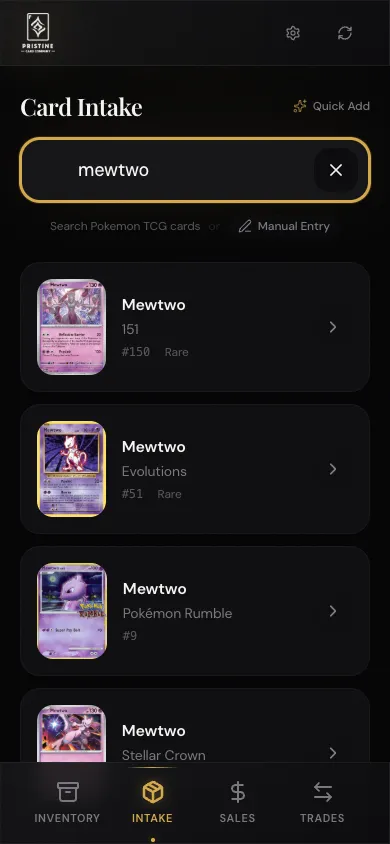
Early Pristine Card Co web app at phone width: card intake running right in a mobile browser, months before we built a native app. Build
The name and multi-tenant rebuild
In January 2026, the name SlabStack appeared in our first strategy doc. On March 1, I started the SlabStack monorepo and rebuilt the product for multiple shops. Within days, each shop had isolated data, signup, and an onboarding checklist.
Build
Web first, on purpose
We stayed on the web through the spring on purpose. Shipping to a browser meant we could push updates right away, put new ideas in front of shops the same day, and learn what held up at a card show before committing to a native app.
Features piled up fast while we tested with shops:
- March: theme and color customization (light, dark, gold, and custom accents), CSV export on reports, spreadsheet import, show expense tracking, and the grading hub for tracking submissions.
- April: early field tests of card scanning in the browser.
- June: a customer-facing buyer portal, launched in alpha with Pristine Card Co and expanded with showcases and campaigns from alpha feedback, plus show calendar discovery.
- Across the spring: reporting rebuilt several times as we learned how shops actually read profit, trades, and show costs.
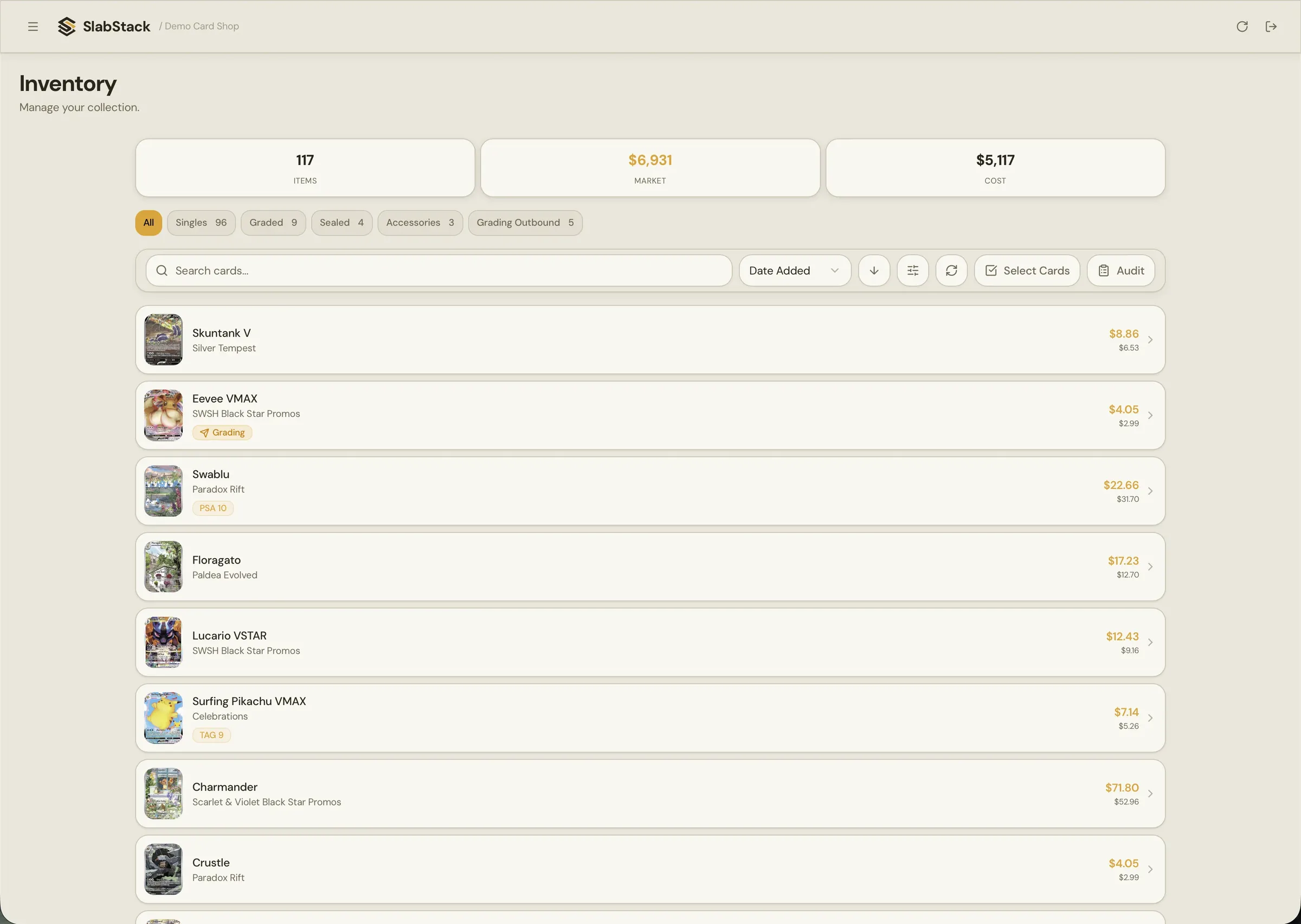
April 2026: the multi-tenant web inventory screen (sample data). Build
SlabStack is born
Pristine Card Co’s owners shared the early app with their own network and saw that other people wanted it too. They pitched making it publicly available so we could test the market. We started giving outside vendors access in March, and the first one was vending with it at card shows before the LLC paperwork was final. On April 10, we formed the LLC, and that same month we launched the public landing page and self-serve signup at slabstack.app.
Build
The scanner forced the move
Card scanning was what finally broke the web-first plan. Earlier in the spring, I had an AI agent build our first scanner inside a separate prototype repo to see how far on-device recognition could go in a mobile browser. iOS Safari did not have enough memory for the on-device model we wanted, so the web scanner had to lean on server calls and took 2 to 5 seconds per scan.
- Web scanner, per scan
- 2 to 5 seconds
- Native, on-device
- under 500 milliseconds target
On July 5, a native iOS proof of concept, built with an AI agent, pointed to the target we wanted: under 500 milliseconds on-device. That settled it. On July 10 we started moving the whole app to React Native, and we finished the move in August.
Mobile
The iPhone app, Vault, and Show Mode
Card shows happen on your feet, not behind a laptop. Early TestFlight builds went to testers in July, and from July 10 we rebuilt the experience as a React Native app with native Swift card-scanner modules. By August, the core move was done: Vault brought inventory, scanning, and reports onto the phone, with Show Mode for ringing up sales right at the table. We kept expanding the app through the fall before opening the public TestFlight beta in November.
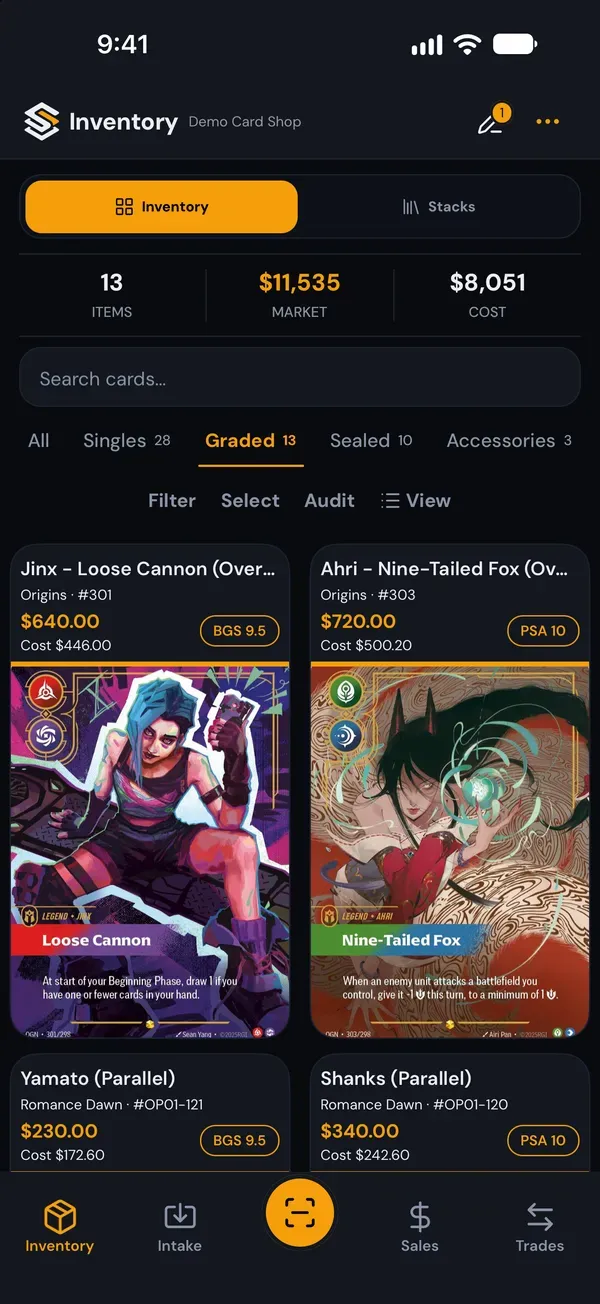
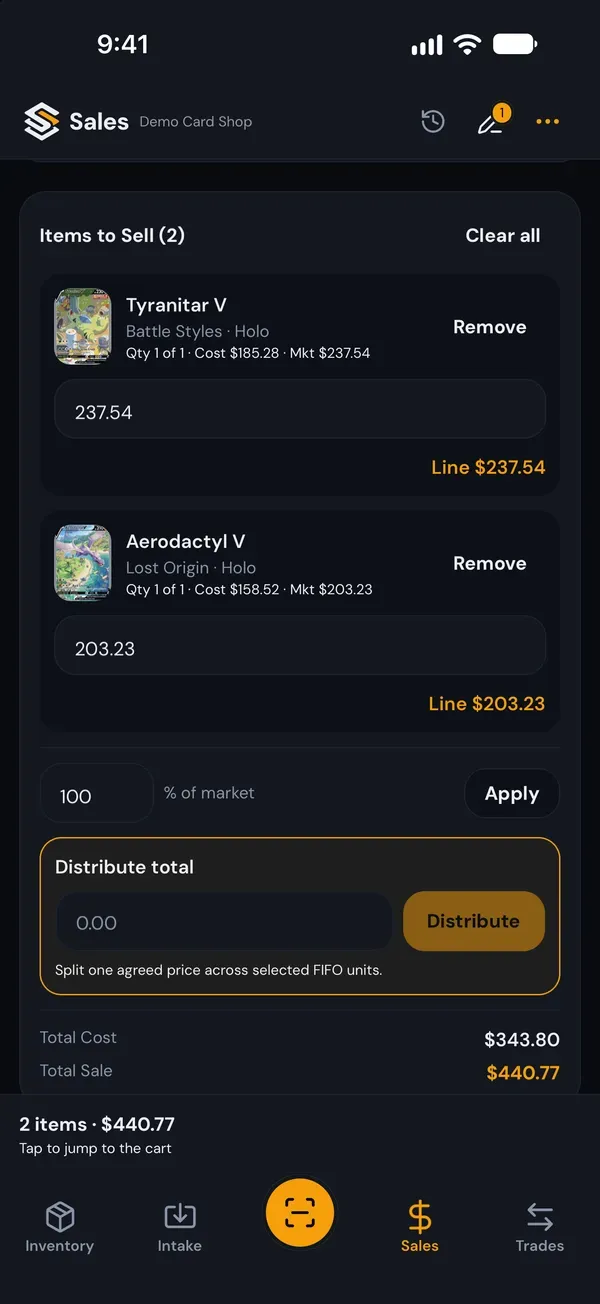
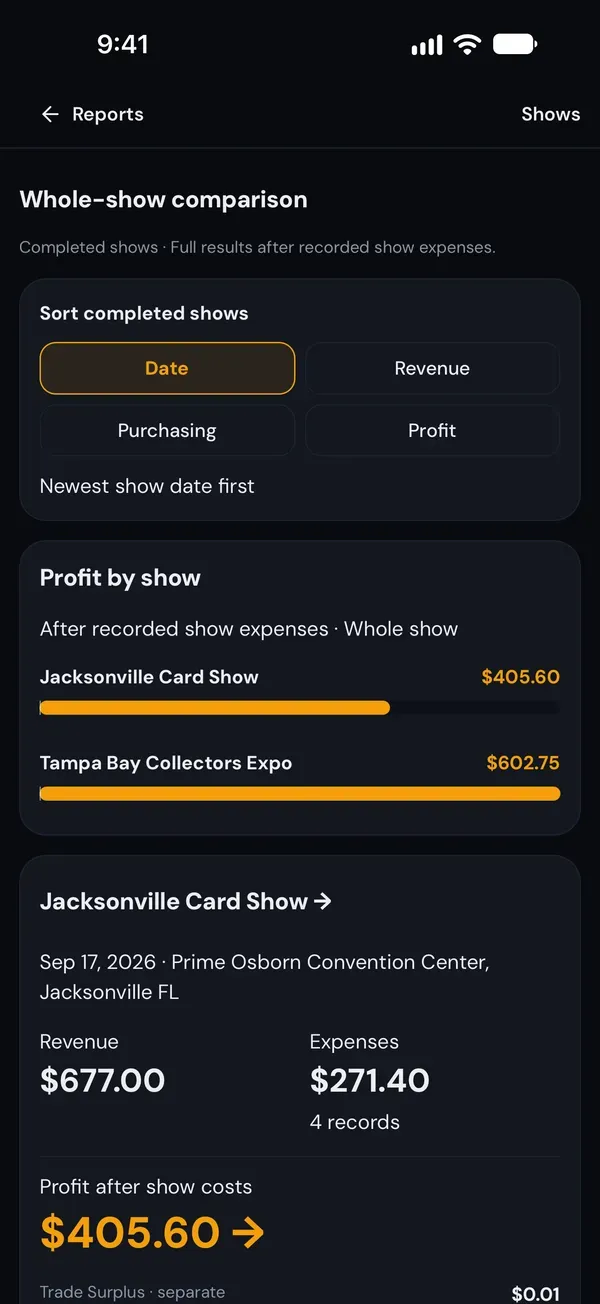
The iPhone app (sample data): graded inventory, a sales cart at the table, and profit by card show. Operate
The coordinator, desk, and council
In October, the build shifted into an operating model. A coordinator agent started watching our Discord channels, shared inbox, CI, and feedback, turning open questions into decision cards on my desk. For calls with lasting cost, a council of agents from different labs reviews the options independently before a recommendation reaches me.
AI
Bring-your-own-AI for shops
On November 1, we shipped an MCP agent connector so shop owners can connect assistants such as ChatGPT, Claude, or Grok to ask about sales and stock and set up automations. Every change waits for the shop owner’s approval, with undo built in. The same November push shipped a rebuilt spreadsheet import and PSA grade receiving with certificate scanning.
Mobile
Public TestFlight beta and live shops
In mid-November, we opened the iPhone app to a public TestFlight beta, inviting testers straight from slabstack.app. The app is in TestFlight beta and not yet in the App Store. As of November 2026, 50+ shops have signed up and recorded $700K+ in sales.
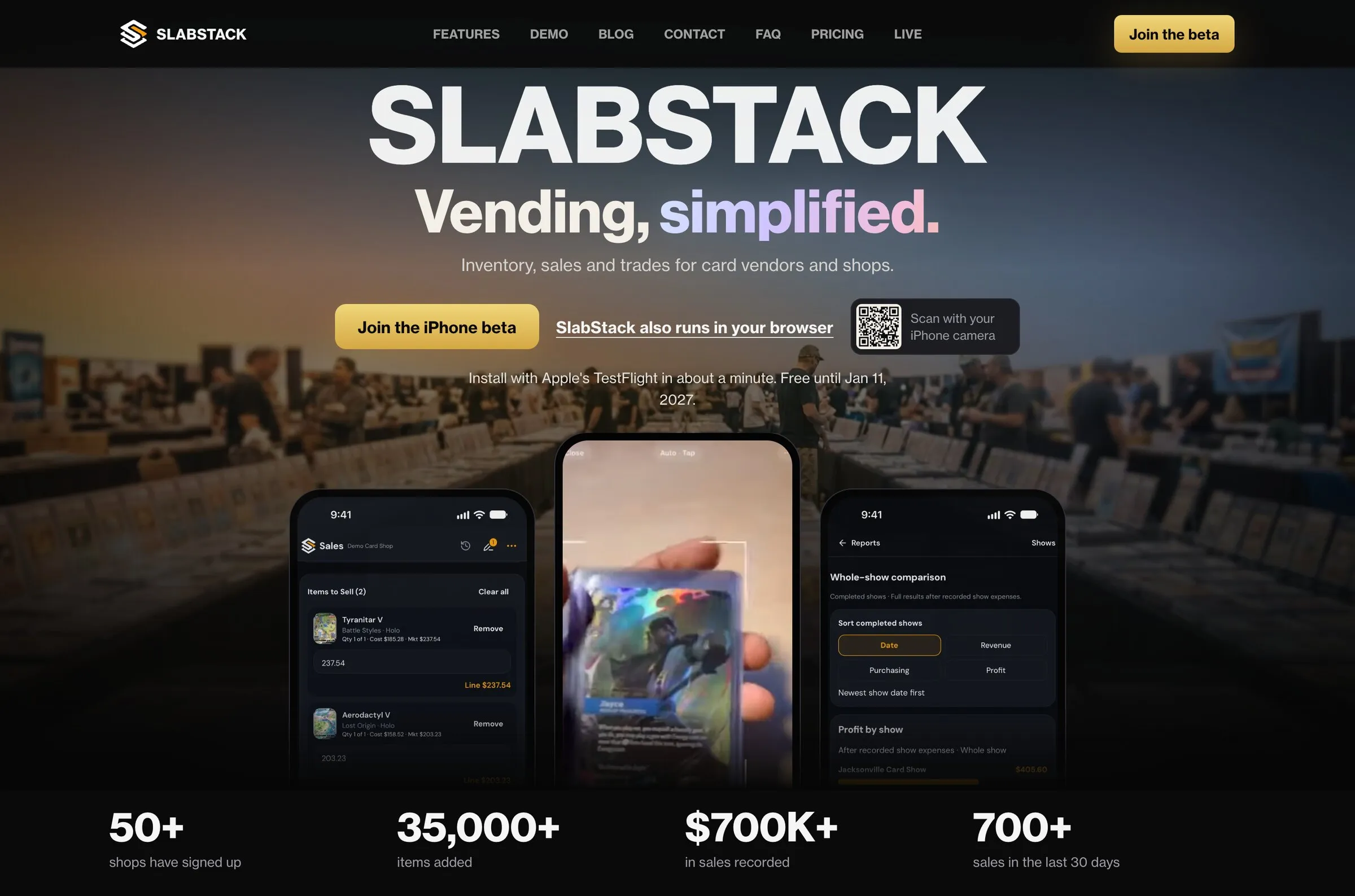
November 2026: public traction figures on slabstack.app.
Teaching non-engineers to build with agents
None of the other owners had built digital products before. I was the only one who had spent a career building large-scale e-commerce, analytics, and consumer software. Instead of teaching them how to write code, I taught them how to work with AI agents.
I walked them through the pieces around the agent: skills, MCP servers, a secret manager, Cloudflare for cloud hosting, and PostHog for product analytics. The goal was to help them understand where our data lives, what the different sources are, and how to connect AI to them so they could self-serve. Along the way, I kept sharing articles, new skills, and new ways of working as new agent capabilities came out. In the repository, we keep a front-door guide written for any owner’s AI agent and an AGENTS.md rulebook for coding agents.
That turned non-engineers into builders alongside me. One of my co-owners, who has no engineering background, is now one of the core contributors to the codebase and the second most active after me.
The split is clear. I own the guardrails: CI, security scanning, testing, and automated QA. My co-owners and the agents work inside them, steering the work through instructions and markdown files.
My desk
At this point, routine operations largely run themselves, and I manage the company through decisions and new ideas. Every owner decision lands on my desk as a card with clear options, context, and a recommendation.
At the top of the desk, the agent ranks a Next up list so I see what is blocking work first. I pick an option or write a short note and press Send. On its next check-in, the coordinator reads my answer, acts on it, and logs the outcome.
When I spot a new idea, I hand it to the coordinator and ask whether it is worth evaluating. Sometimes the answer is yes, and it enters the loop. Each of the four owners also has a desk view with their own Next up items and question box, so agents can work on behalf of all four of us.
The screenshots below show neutral sample data from the desk interface.
The whole loop behind the desk is on How I work.
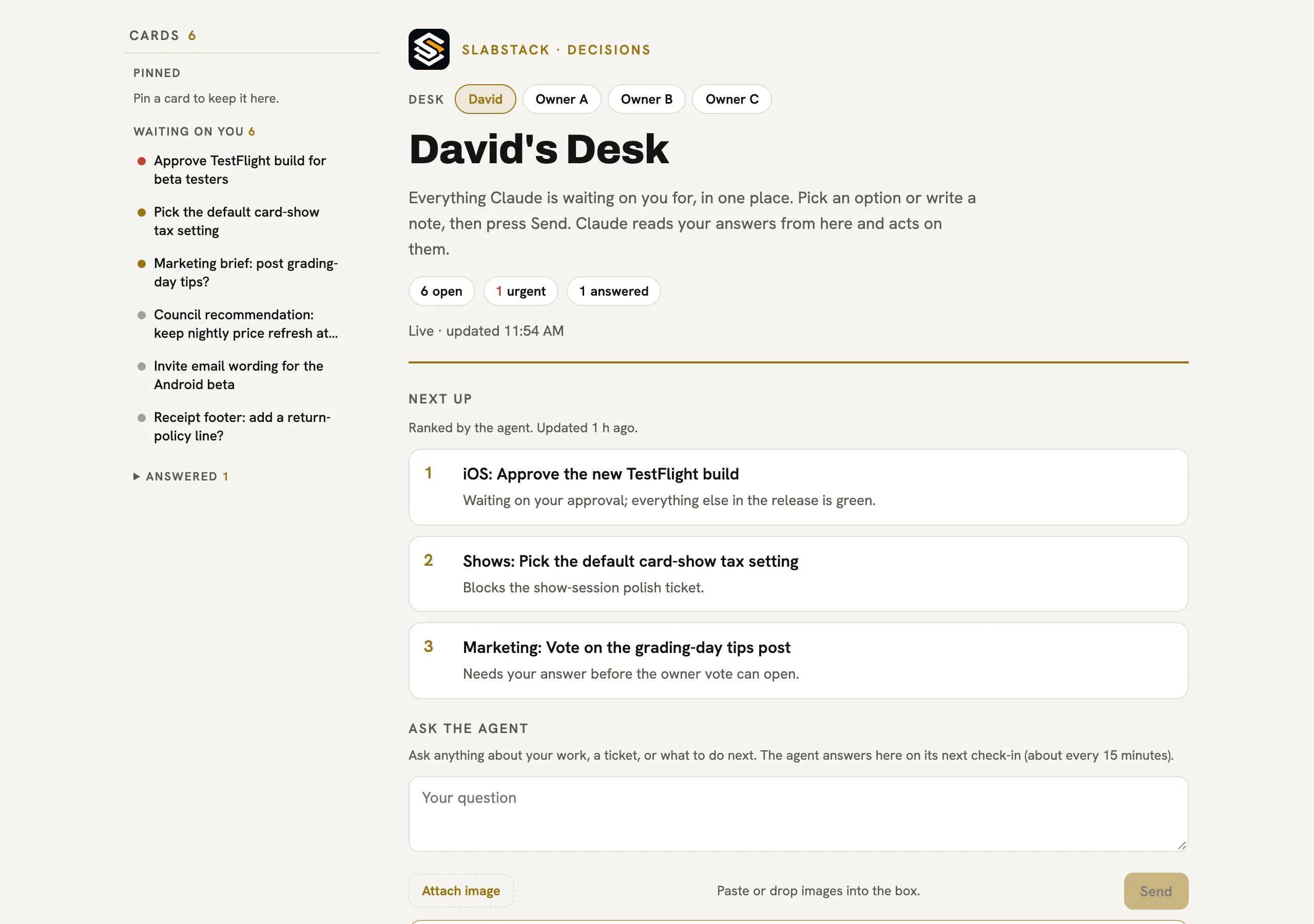
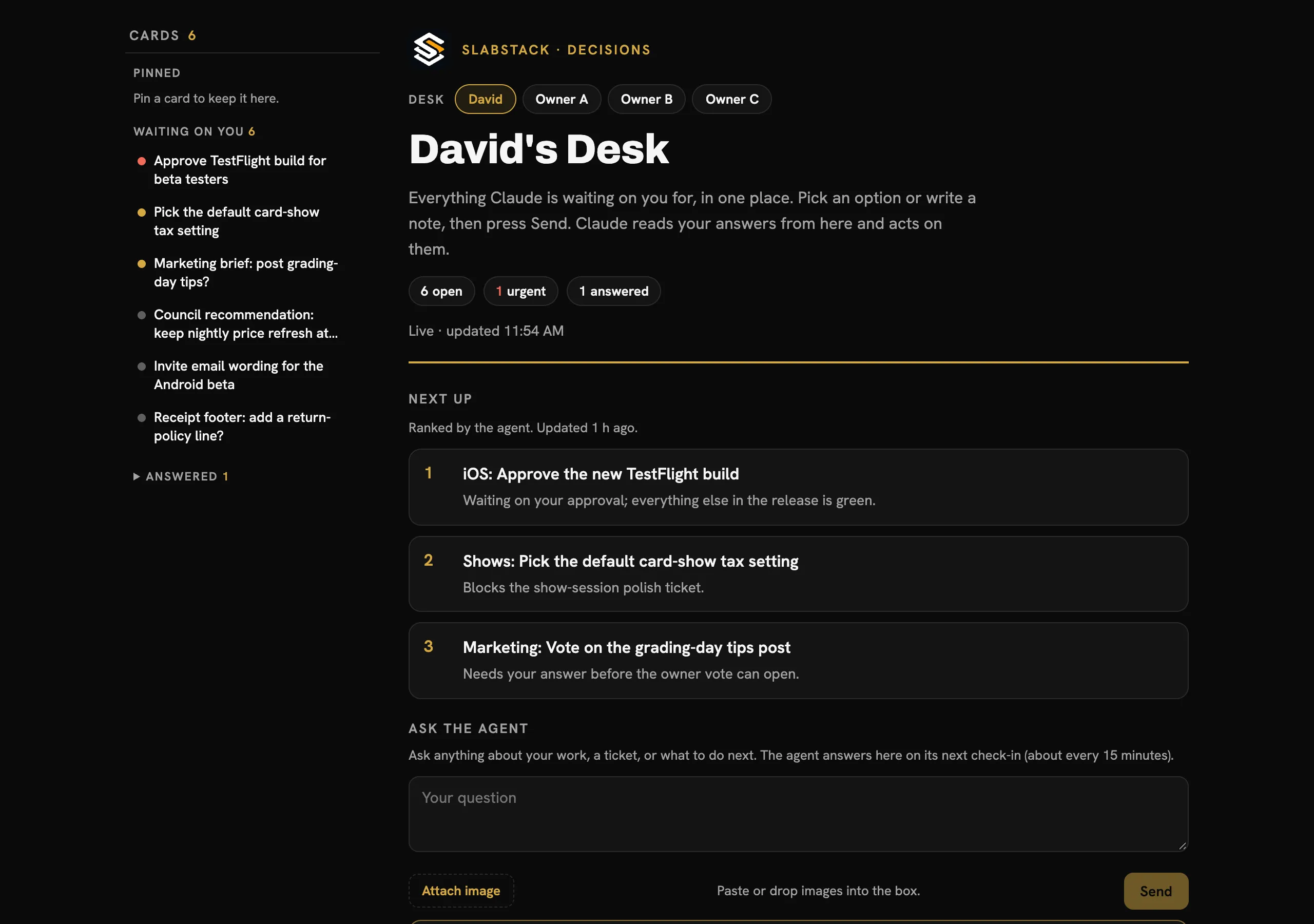
Open full size: Overview of David's Desk with sample data: an owner switcher bar at the top, a sidebar of waiting decision cards on the left, a ranked Next up list in the center, and an Ask the agent input box below.Open full size: Overview of David's Desk with sample data: an owner switcher bar at the top, a sidebar of waiting decision cards on the left, a ranked Next up list in the center, and an Ask the agent input box below.
- Next up, ranked by the agent
- Waiting cards
- Owner switcher
- Ask the agent
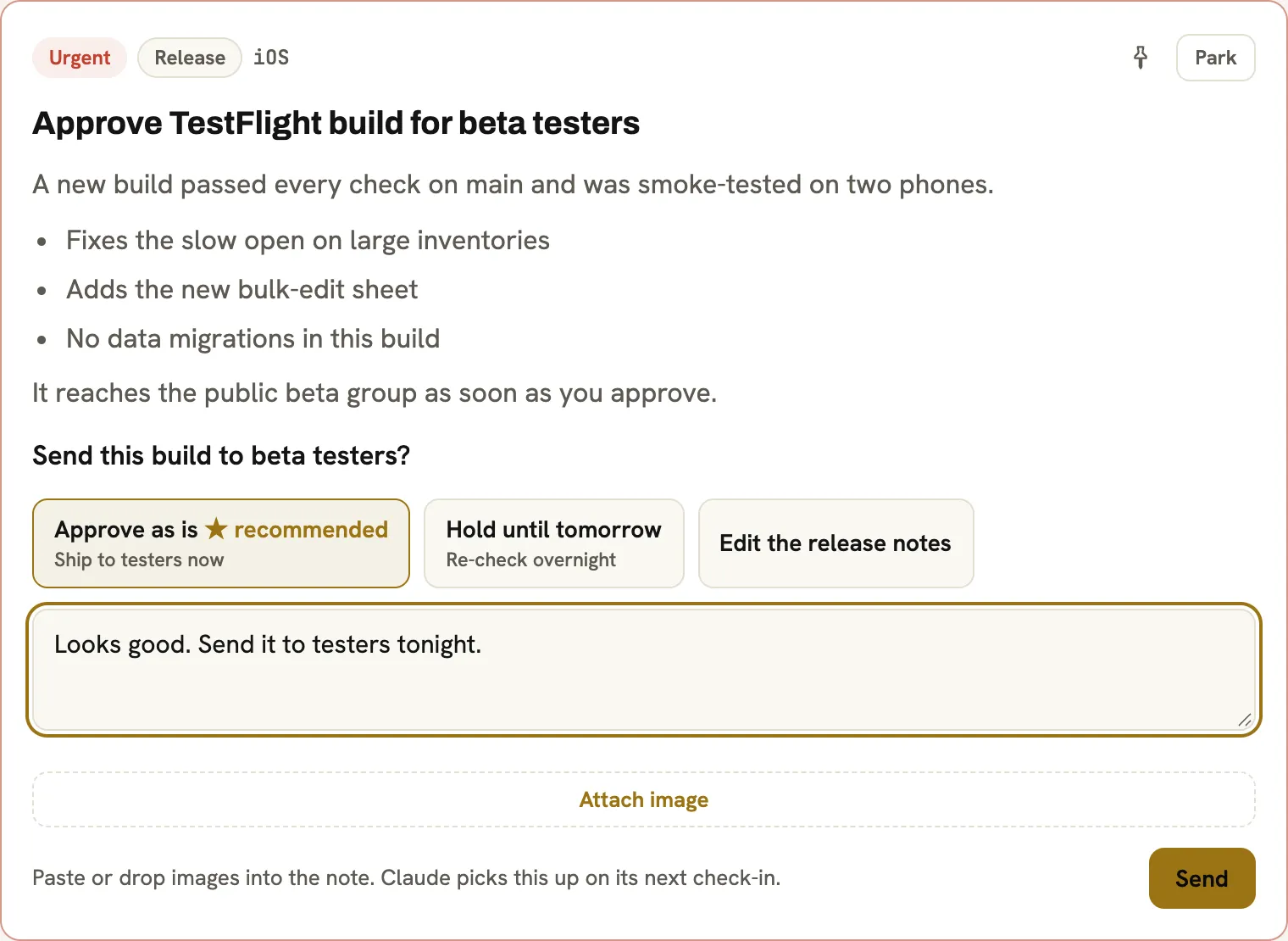
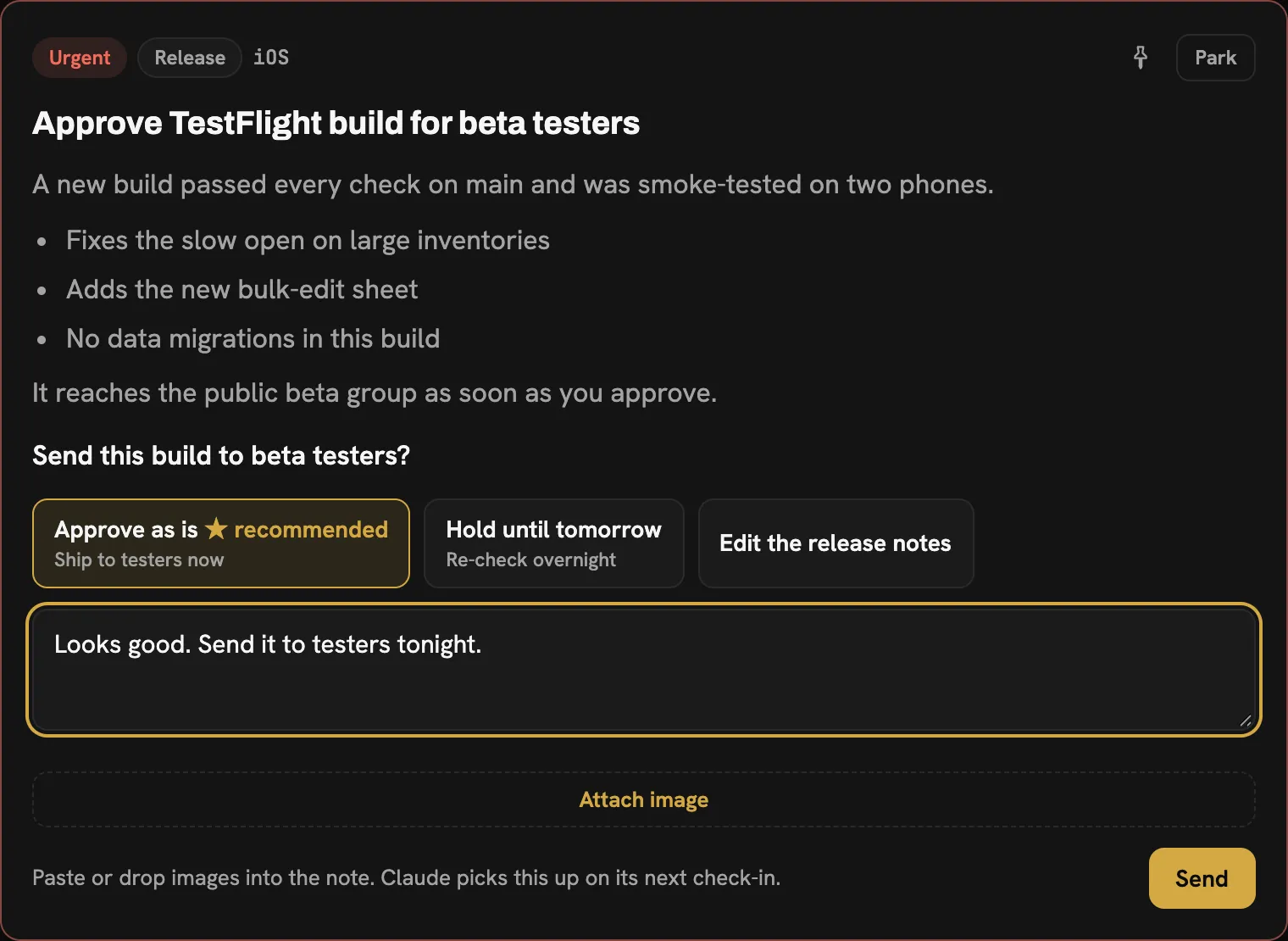
Open full size: Close-up of an urgent release decision card with sample data: bulleted build notes, option buttons with one marked recommended, a short reply in the note box, and a Send button.Open full size: Close-up of an urgent release decision card with sample data: bulleted build notes, option buttons with one marked recommended, a short reply in the note box, and a Send button.
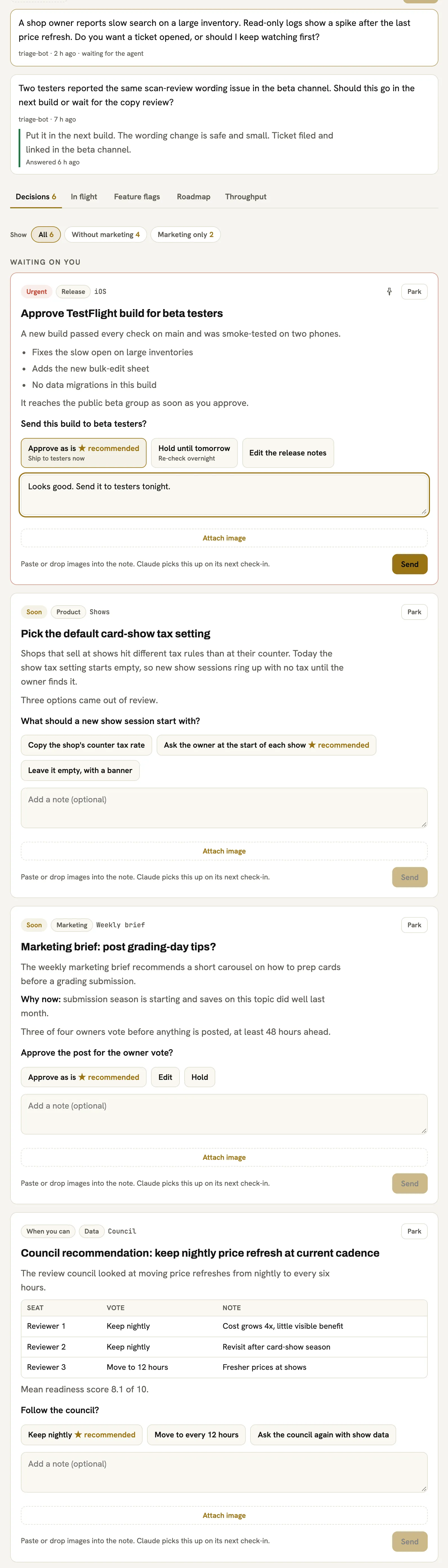
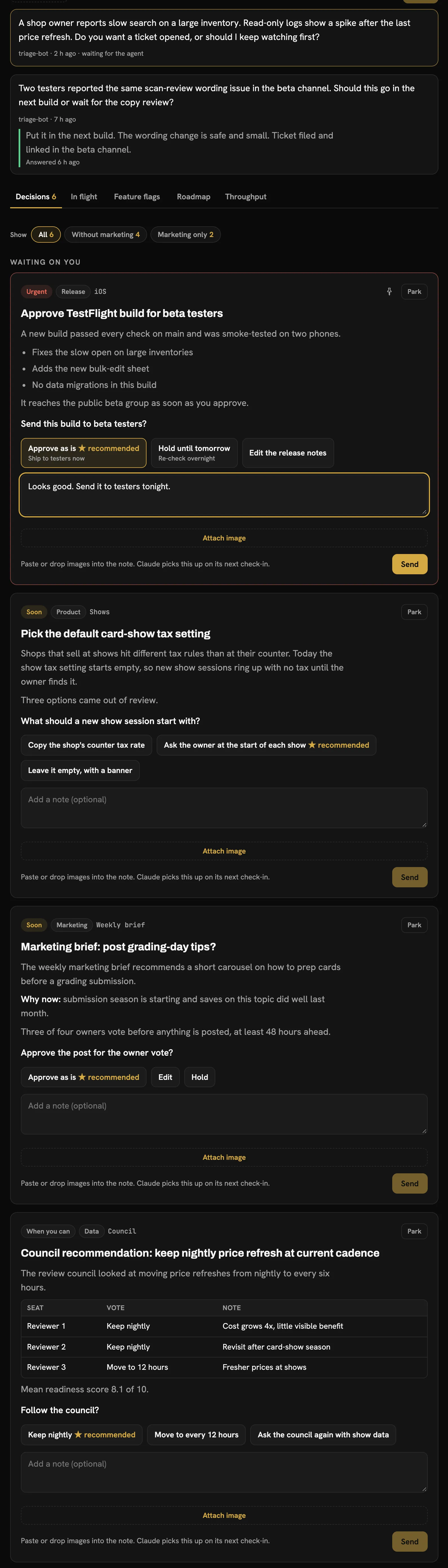
Open full size: Scrolled view of David's Desk with sample data showing recent triage questions, filter tabs, and a vertical queue of decision cards for release approval, product settings, a marketing brief, and a council recommendation table.Open full size: Scrolled view of David's Desk with sample data showing recent triage questions, filter tabs, and a vertical queue of decision cards for release approval, product settings, a marketing brief, and a council recommendation table.
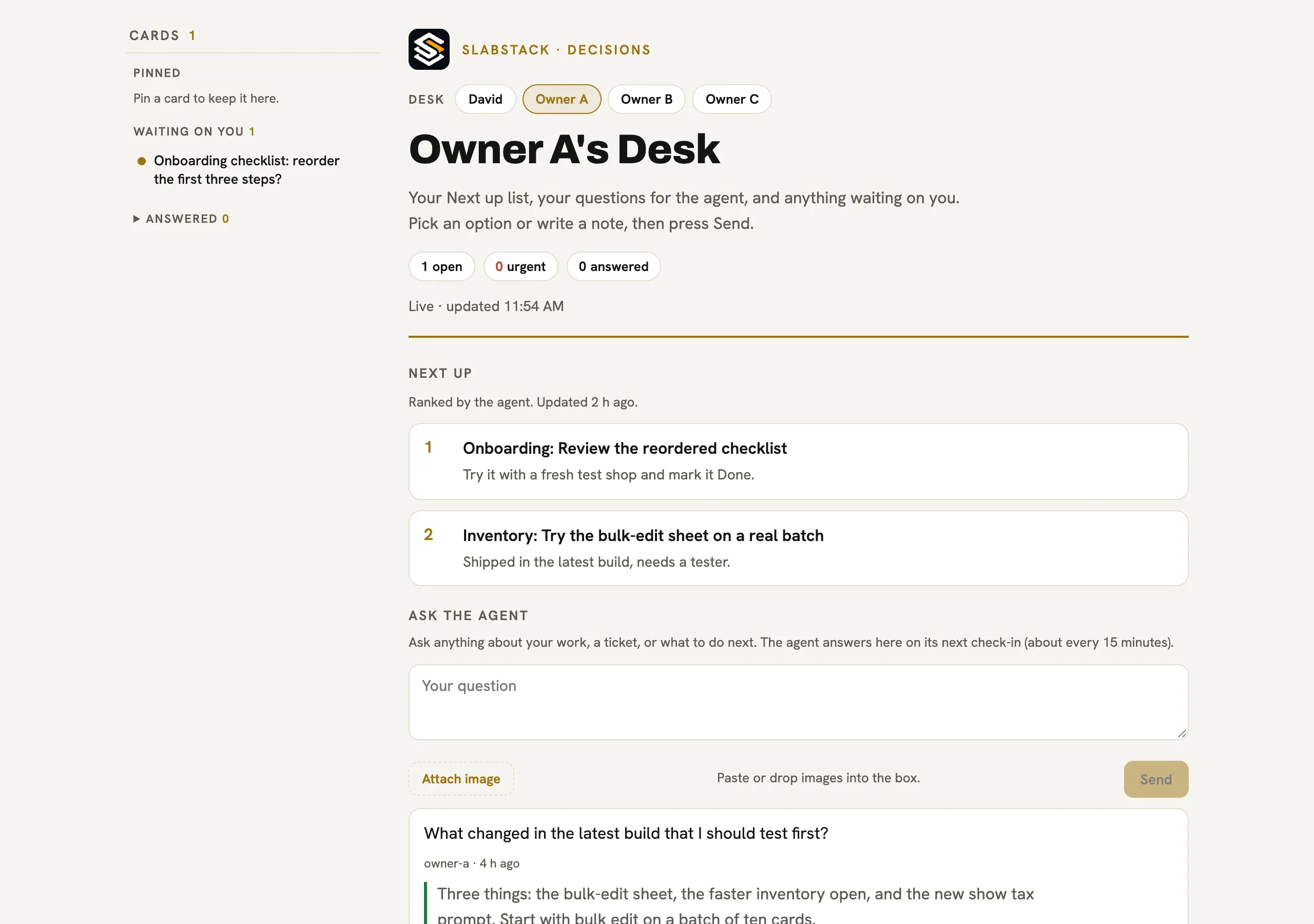
Open full size: Owner A's Desk with sample data: a waiting card in the left sidebar, a ranked Next up testing list, an Ask the agent box, and an answered question about what changed in the latest build.Open full size: Owner A's Desk with sample data: a waiting card in the left sidebar, a ranked Next up testing list, an Ask the agent box, and an answered question about what changed in the latest build.
How the operating loop runs
- AgentThe coordinator watches Discord, the shared inbox, feedback, and marketing briefs, or evaluates a new idea I hand it
- AgentA council of agents from different labs weighs hard calls with lasting cost
- DecisionA decision card lands on my desk, and I make the call
- AgentAgents build, test, clear automated pull-request review, and cut TestFlight builds
- AutomatedScheduled jobs run nightly backups, security checks, price refreshes, inventory snapshots, and weekly catalog syncs
- DecisionOwners vote on public posts and approve releases
- Coordinator heartbeat. A coordinator agent checks in every few minutes to watch our Discord channels, the shared inbox, CI, the merge queue, open pull requests, TestFlight builds, and stale work, turning actionable items into decision cards.
- Owner desks. Decisions land on my desk as structured cards with clear options. Each of the four owners has a desk with their own Next up list, built so agents can work on behalf of all four of us.
- Discord triage bot. A triage bot on a separate machine answers me and my co-owners in Discord with read-only diagnostics and hands work straight to the coordinator.
- Council of agents. When a call has lasting cost, such as pipeline policy or release defaults, a council of agents from different labs reviews the artifact independently before a recommendation reaches my desk.
- Chief of marketing. A marketing agent produces a weekly brief, surfaces marketing opportunities and feature ideas, and drafts social posts for owner review.
- Pull-request review and scheduled jobs. Every pull request passes an automated agent review before merge. Scheduled jobs handle retries, nightly backups, security checks, price refreshes, inventory snapshots, TestFlight feedback forwarding, developer-tool maintenance, and automatic catalog updates.
- Shop-side AI with guardrails. Inside the product, shop owners can connect assistants such as ChatGPT, Claude, or Grok through MCP to ask about sales and stock and set up automations, approving every change before it happens and keeping undo.
Where the owners stay in charge
The coordinator keeps the company moving, but none of this runs without oversight. Every decision that carries real weight still lands on a person, whether on my desk, with the four of us together, or inside a shop’s own account:
- I work through the decision cards on my desk and set the guardrails for the business.
- Public posts go to an owner vote before anything publishes.
- Releases wait for approval, and the iPhone app stays in TestFlight beta until we decide to ship to the App Store.
- Inside each shop, the shop owner approves every AI-proposed change before it happens, with undo built in.
How I measure it
Output is simple to count: 2,742 commits of mine on main since March 2026, not counting automated test commits. The agents are my tools, so I count the work together rather than crediting a single model.
Commits measure output, not value. What counts is real adoption: 50+ shops signed up and $700K+ in sales recorded as of November 2026.