Method
How I work
I run my projects through one driver agent on a short heartbeat. Behind it is a bench of agents from different labs, routed by what each one does best. Talk happens in chat, while decisions land on my desk so I can always see where things stand.
The working loop
- Wakes on schedule: Heartbeat to Driver (Claude Code)
- Routes by strength: Driver to Bench: Claude sub-agents (Opus, Sonnet, Haiku, Fable), Codex (Sol, Astra, Luna), Antigravity (Gemini Neon)
- Returns reports: Bench to Driver
- Scores hard calls: Driver and Council
- Ranks decision cards: Driver to Desk
- Shows where things stand: Desk to David
- Answers & sets rules: David to Driver
- Agent
- Human decision
- Schedule or surface
The driver and its heartbeat
One main session in Claude Code drives the work. Instead of waiting for me to nudge every step, it runs on a short heartbeat, waking every few minutes to check CI, shared inboxes, open pull requests, and anything sitting stale.
It can also schedule its own follow-ups and recurring jobs. When a build needs watching, a review needs a second pass, or a routine sync has to run later in the week, the driver puts that on its own schedule. Between check-ins, it sends written briefs to other agents and reads their reports when they come back. Work keeps moving while anything that needs a real call waits for me.
The bench
The driver does not do everything itself. It can call a bench of agents across labs: Claude sub-agents (Opus, Sonnet, Haiku, and Fable) for focused or parallel work, OpenAI's Codex CLI (Sol, Astra, and Luna) including computer use in a real browser or Mac apps, and Google's Antigravity with Gemini Neon.
The goal is for the driver to learn from results where each agent flourishes. I give it a push with standing guidance. Anything involving 3D modeling or 3D images goes straight to Astra and Fable. Design work goes to Fable, Opus, and Gemini Neon, with Fable leading and the group acting as a design sub-council. Each agent gets a written brief and sends a report back.
Standing orders
- 3D modeling and 3D images
- Astra
- Fable
- Design work
- Fable leads
- Opus
- Gemini Neon
Design sub-council
Set by me
Councils for hard calls
Single agents can talk themselves into a bad answer, and different labs have different blind spots. When agents disagree, or when a choice carries lasting cost, the driver convenes a council.
Independent agents from different labs read the same brief separately and score it on their own: GO, GO WITH CHANGES, or NO-GO. The driver collects the ballots, merges the votes, and surfaces where the models split. Instead of one smooth pitch, I get the consensus, the dissent, and the specific risks in front of me before I make the call.
- GO
- GO WITH CHANGES
- NO-GO
The desk
Active chat is for talking things through, not for tracking open calls. When something needs an answer, it leaves the thread and lands on my desk as a decision card with context, clear options, and a recommendation.
The driver ranks what is next so blockers sit at the top. Whenever I need to check in, I open the desk, see where things stand, pick an option or leave a short note, and send it. On its next heartbeat, the driver reads my answer and acts on it. The production version of this runs every day in SlabStack, where each owner gets their own desk so agents can work on behalf of the whole team.
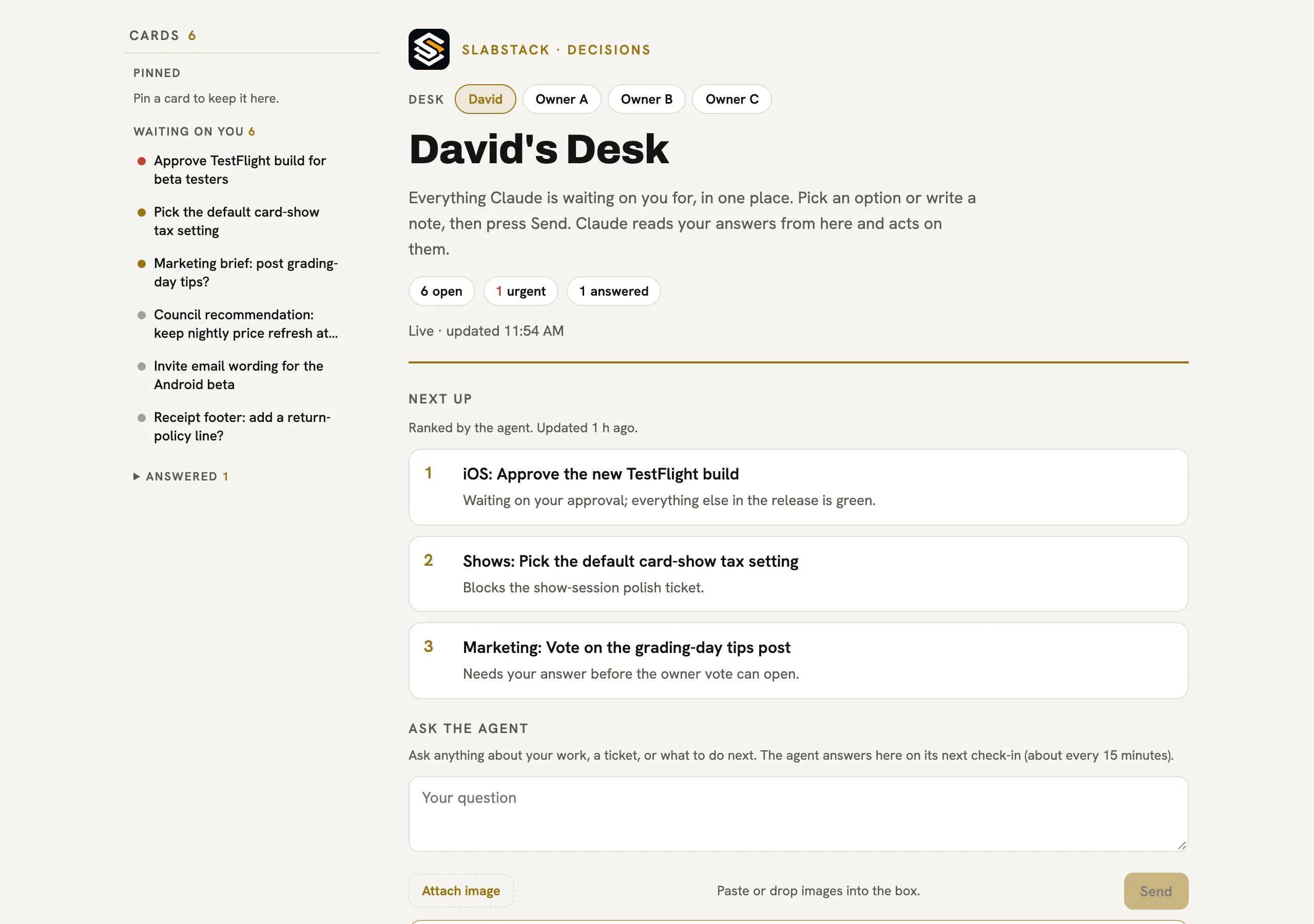
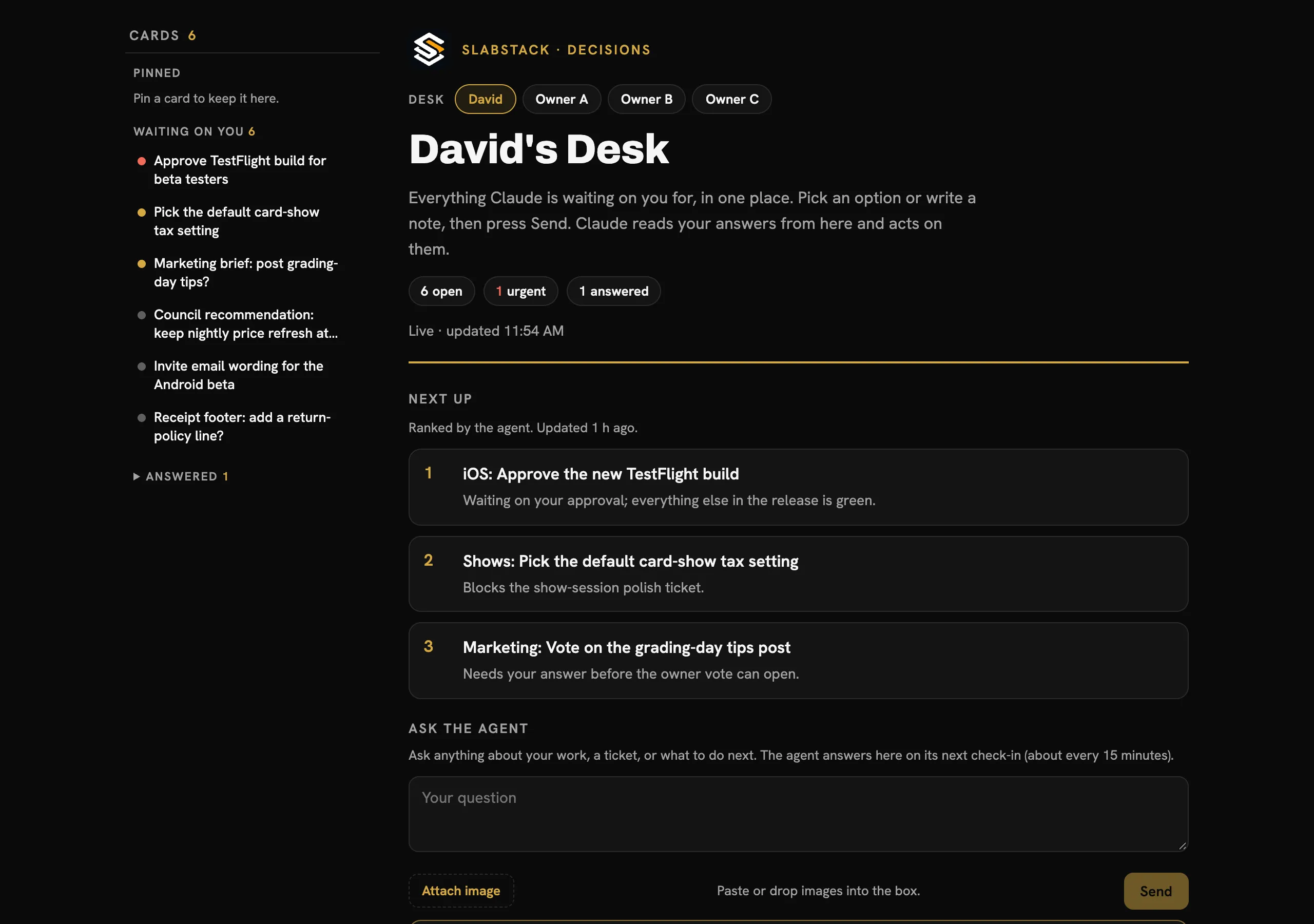
Open full size: Overview of David's Desk with sample data: an owner switcher bar at the top, a sidebar of waiting decision cards on the left, a ranked Next up list in the center, and an Ask the agent input box below.Open full size: Overview of David's Desk with sample data: an owner switcher bar at the top, a sidebar of waiting decision cards on the left, a ranked Next up list in the center, and an Ask the agent input box below.
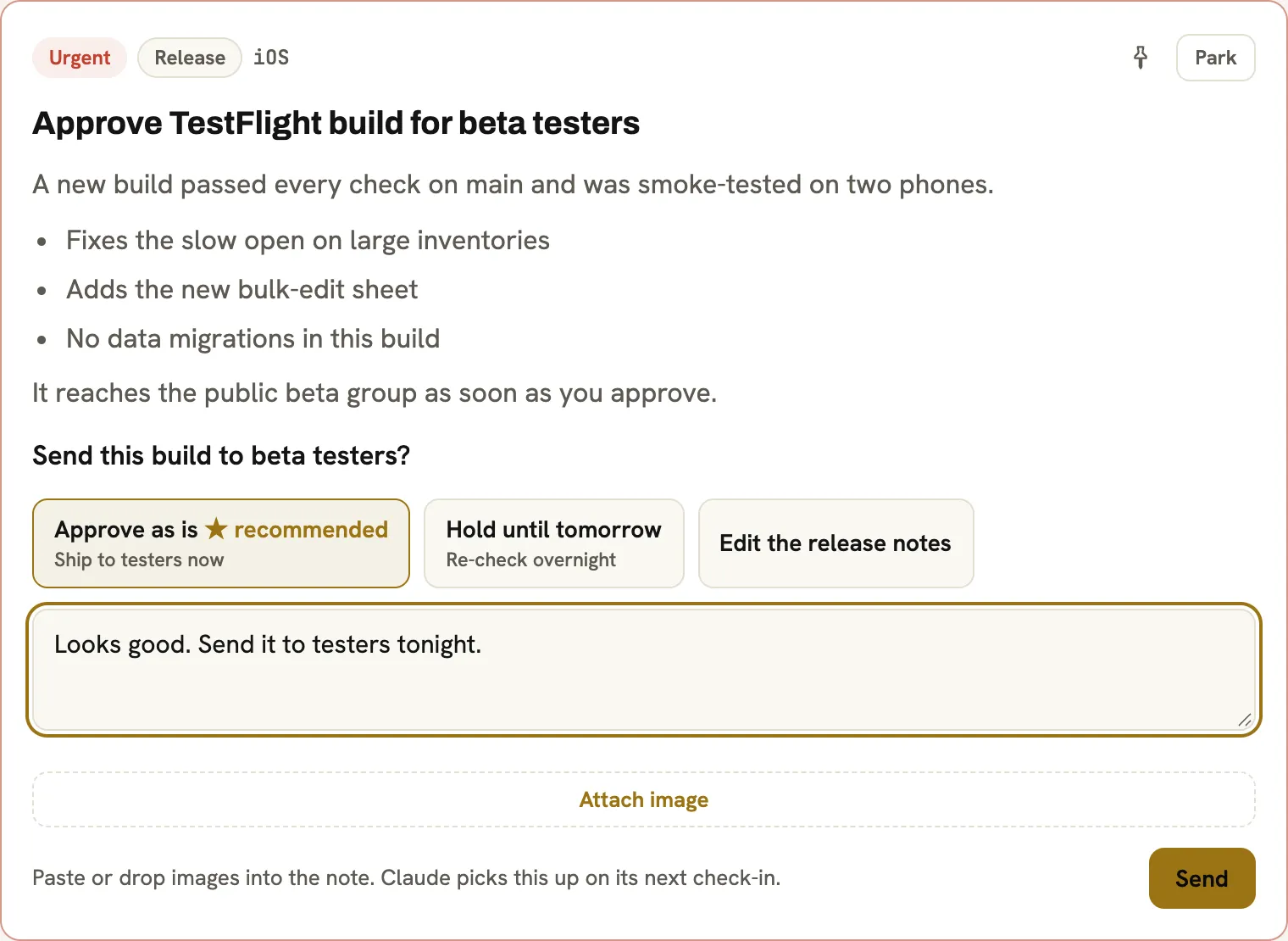
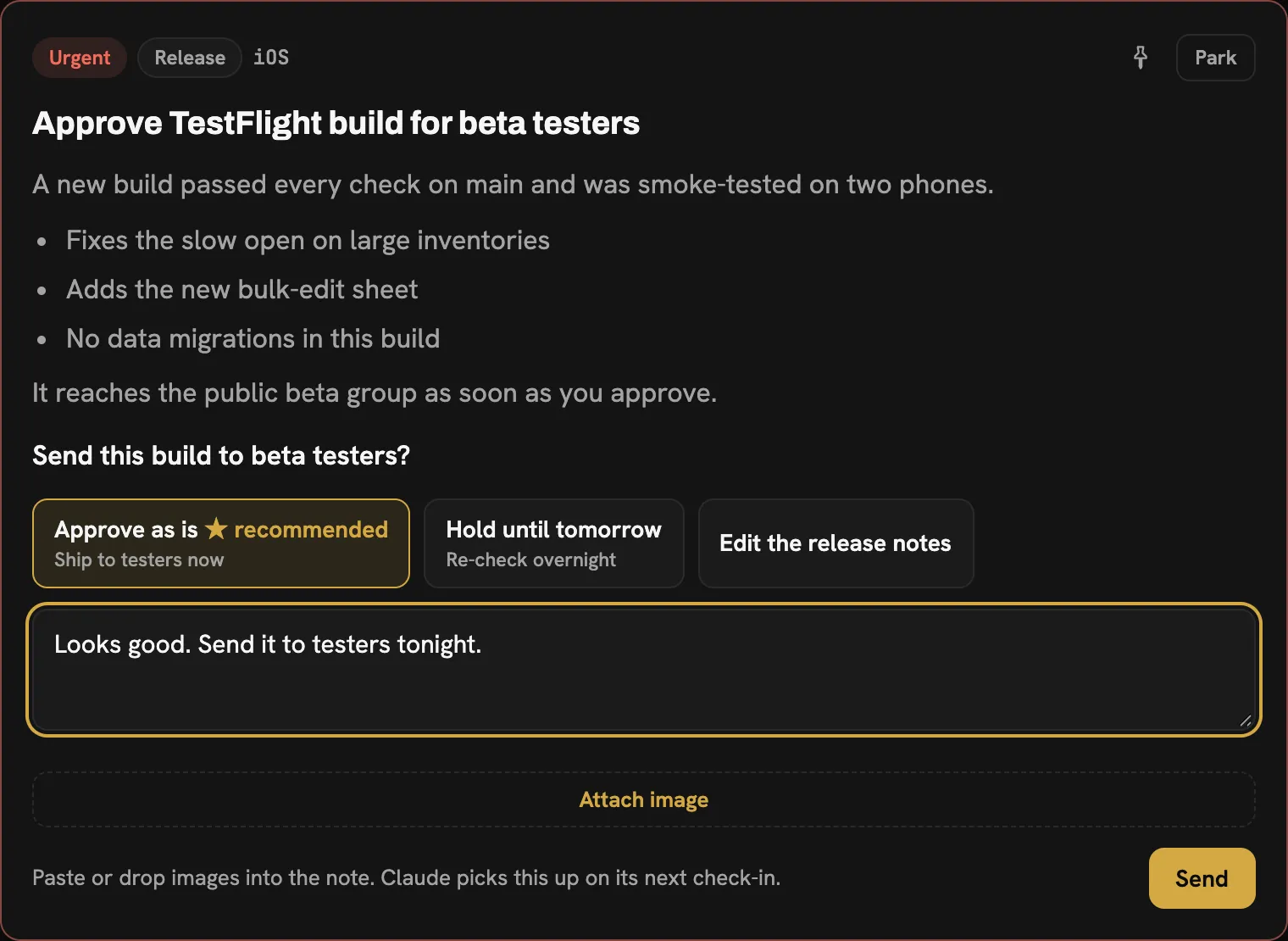
Open full size: Close-up of an urgent release decision card with sample data: bulleted build notes, option buttons with one marked recommended, a short reply in the note box, and a Send button.Open full size: Close-up of an urgent release decision card with sample data: bulleted build notes, option buttons with one marked recommended, a short reply in the note box, and a Send button.
How this site was built
This site went through the same loop. Claude Code ran as the driver, coordinating the build and verifying each pass. Fable designed and built the layouts and animations. Gemini Neon wrote the copy in my voice from my notes and transcripts. OpenAI's Codex drove Brave and the iOS Simulator for hands-on browser and iPhone Safari checks.
Before changes shipped, councils of independent agents reviewed analytics and release readiness. My answers did not stay buried in chat history either. Every call I made while reviewing pages by speech to text landed in a single decisions ledger that every agent worked from.
Who did what
- Driver
- Claude Code Coordinated the build and verified each pass
- Design and build
- Fable Layouts and animations
- Copy
- Gemini Neon In my voice, from my notes and transcripts
- Hands-on checks
- OpenAI's Codex Brave and the iOS Simulator
- Review
- Councils Analytics and release readiness
- Decisions
- David Every call, in a single decisions ledger
What stays with me
None of this runs on autopilot, and it is not meant to. Agents do the legwork, watch the routine loops, and lay out the tradeoffs. The judgment stays with people.
I set the direction, the guardrails, and the standing rules for which agent handles what. I answer the cards on my desk. On SlabStack, my co-owners and I vote on public posts and approve releases before anything goes out. On this site, I look at the real pages, talk through what works and what feels off, and decide what ships. Fast tools make clear human decisions more important, not less.